


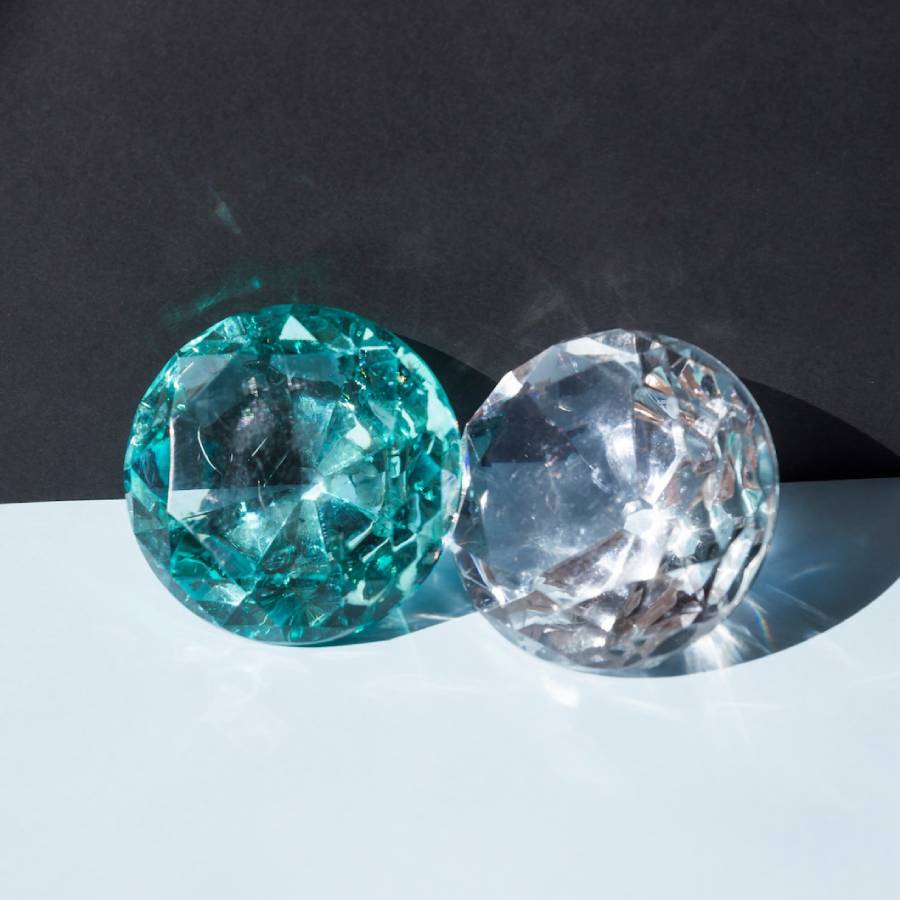
Diamond shopping looks different from what it did five years ago. An engagement ring purchase used to mean choosing among cuts, colors, clarities, and carats within naturally mined stones. Houston buyers walking into a jewelry store in 2026 face a question their parents never had to answer. Mined or made. In today’s market in 2026, in a very basic comparison, $5k in a natural diamond roughly gets you a round 1.5ct GIA-certified H color, VS2, with very good cut and moderate to no fluorescence. That same $5k can get you roughly a round 5 ct lab-grown diamond with EF color and VS clarity.
The natural diamonds vs. lab-grown decision has become the most-asked question at Houston jewelry counters. Both options are chemically identical diamonds. Both arrive at Houston jewelers through different supply chains but end up in adjacent cases on the same showroom floor. The differences lie in origin, price, and the meaning each carries for the wearer.
This guide compares both paths objectively. No bias toward one direction or the other. Some Houston buyers want the geological story of a stone formed before the dinosaurs walked the Earth. Others want twice the carat weight for the same budget. Both groups leave the jewelry store happy when they understand what they actually bought.
Origin and Formation
A natural diamond is the product of unimaginable time and pressure. Pure carbon, sitting eighty to a hundred and twenty miles below the surface, gets crushed under conditions that take a billion years or more to convert it into crystalline diamond. Volcanic eruptions, millions of years later, carry the formed stones toward the surface inside kimberlite pipes. Mining operations finish the journey by extracting and processing them for sale.
Laboratories accomplish the same chemistry in a matter of weeks. HPHT uses high pressure and high temperature to grow diamonds from carbon seeds. CVD pumps methane and hydrogen gas into vacuum chambers heated to eight hundred degrees Celsius, building the stone atom by atom. A rough one-carat diamond can finish growing in roughly three to four weeks inside one of these chambers.
What comes out of either process is identical at the atomic level. Same carbon. Same lattice arrangement. Same hardness, same fire, same light behavior under any condition you can subject it to. The only thing that differs between a natural and a lab-grown diamond is how the carbon is arranged.
Visual Comparison
Looking at the two side by side, even an experienced jeweler usually cannot tell them apart. The naked eye has no chance. The FTC, GIA, and IGI all confirm this directly. Identification requires laser inscription on the girdle, calibrated lab-grown testers, or formal certification analysis at a recognized laboratory.
The sparkle a customer sees across a dinner table is the same. The fire under afternoon sunshine through a window is the same. Cut quality, color grade, and clarity grade matter. Origin contributes nothing visible to the stone’s performance in actual use.
A buyer comparing two well-cut diamonds at similar grades sees two beautiful diamonds. The only way to know which one started on Earth and which one started in a chamber is to read the documentation.
Price Point Analysis
The price gap is where the practical decision usually gets made. A budget of $5,000 at a Houston jeweler today buys roughly a 0.7-1.0 carat natural diamond with VS clarity and near-colorless grade. The same five thousand dollars buys a lab-grown stone in the two- to two-and-a-half-carat range at the same clarity and color level.
Across the Houston market, lab-grown stones run 60 to 75% less than natural stones at comparable specifications. A four-carat lab-grown costs about what a one-carat natural costs at similar quality grades. The gap has widened over the past three years rather than narrowed, as lab-grown supply has expanded faster than demand has caught up.
Most Houston jewelers price each category against current wholesale benchmarks rather than fixed historical multiples. A side-by-side comparison at a single jeweler usually gives the most accurate read on the price gap for any given week.
Rarity and Value
Natural stones offer something lab-grown cannot. Call it the geological story, the heirloom characteristic, or the connection to natural processes. A diamond formed before the dinosaurs walked, and brought to the surface by volcanic activity long ago, has a permanence that matters to a meaningful percentage of buyers. The history transfers with the purchase.
Lab-grown stones live in a different category. The right description is “attainable luxury” rather than “scarce luxury”. Buyers choosing them generally prioritize carat weight, clarity grade, and budget flexibility over geological provenance. Both orientations represent legitimate preferences. The market accommodates both well in 2026.
Resale value behaves differently between the two. Historically, natural diamonds have held value for decades, sometimes appreciating depending on quality and market conditions. Lab-grown stones currently sell secondhand at heavy discounts from the original retail price. The long-term resale trajectory for lab-grown remains unclear at this stage of the market, which factors into the resale decisions of buyers who think about resale at all.
Environmental Impact
Mining diamonds disturbs the land. Generates waste. Uses water and energy. These environmental costs are real and well-documented across decades of operation. Modern mining has improved on the environmental front through stricter regulations and supply chain programs such as the Kimberley Process, but its footprint cannot be zero by definition.
Growing diamonds in a laboratory also takes a toll on the environment. HPHT and CVD processes both require sustained energy input over the course of production weeks. Whether lab-grown actually wins the environmental comparison depends entirely on the production facility’s power source. Renewable-energy operations produce stones with substantially lower carbon impact than fossil-fuel-powered operations.
Both options carry environmental costs. Neither runs neutral. The specific costs vary in nature and scale depending on production methods and energy sourcing, and buyers who weigh environmental impact heavily generally prefer producer-level documentation to category-level claims.
Consumer Preferences
Diamond buyers tend to split into two camps when asked what matters most. The first camp values the natural geological story. A stone that took a billion years to form, passed through volcanic processes, and was extracted by humans carries weight beyond its physical properties. These buyers choose natural diamonds specifically for the story embedded in the stone.
The second camp values human achievement. A diamond produced through controlled science, free from mining concerns, available at a price point that lets the budget stretch further, represents technological progress in concrete form. These buyers choose lab-grown for what it signifies about modern production rather than about geological history. Both preferences reflect real values. Neither claims any kind of moral superiority over the other.
The Future-Proof Choice
Houston has accommodated both buyer types well. Houston Diamond Outlet carries a substantial inventory of both natural and lab-grown diamonds across its Galleria, Woodlands, and Sugar Land locations. Most major Houston jewelers now stock both categories. Custom designers work with either stone type based on what each client wants for the design. Resale of lab-grown is either at heavy discounts or not at all. The future of the resale of lab-grown diamonds is bleak at best.
This positions Houston as one of the better markets for direct in-person comparison shopping. Looking at the two categories side by side under controlled lighting at a jewelry counter clarifies the decision faster than any amount of online research ever can. The price gap becomes visible. The visual identity becomes obvious. The personal resonance of each option settles into something the buyer can actually feel rather than something they’re trying to figure out from screens.
The Right Choice Is Personal
No universally correct answer exists in the natural-versus-lab-grown question. Both are real diamonds. Both look the same to the eye. Both come in the full range of grades and shapes available in the market. The right choice depends on which story matters more to the buyer, which budget fits the situation, and which values the buyer wants the ring to reflect across the decades it will be worn.
For Houston shoppers ready to compare both options in person, Houston Diamond Outlet offers extensive selections of natural and lab-grown diamonds at wholesale-to-public pricing. Jay the Jeweler brings more than 30 years of diamond experience to a private-appointment model in which pieces are handpicked before each visit. Comparing options side by side in a low-pressure environment is how most Houston buyers finally land on the right choice.